


 12 / 92

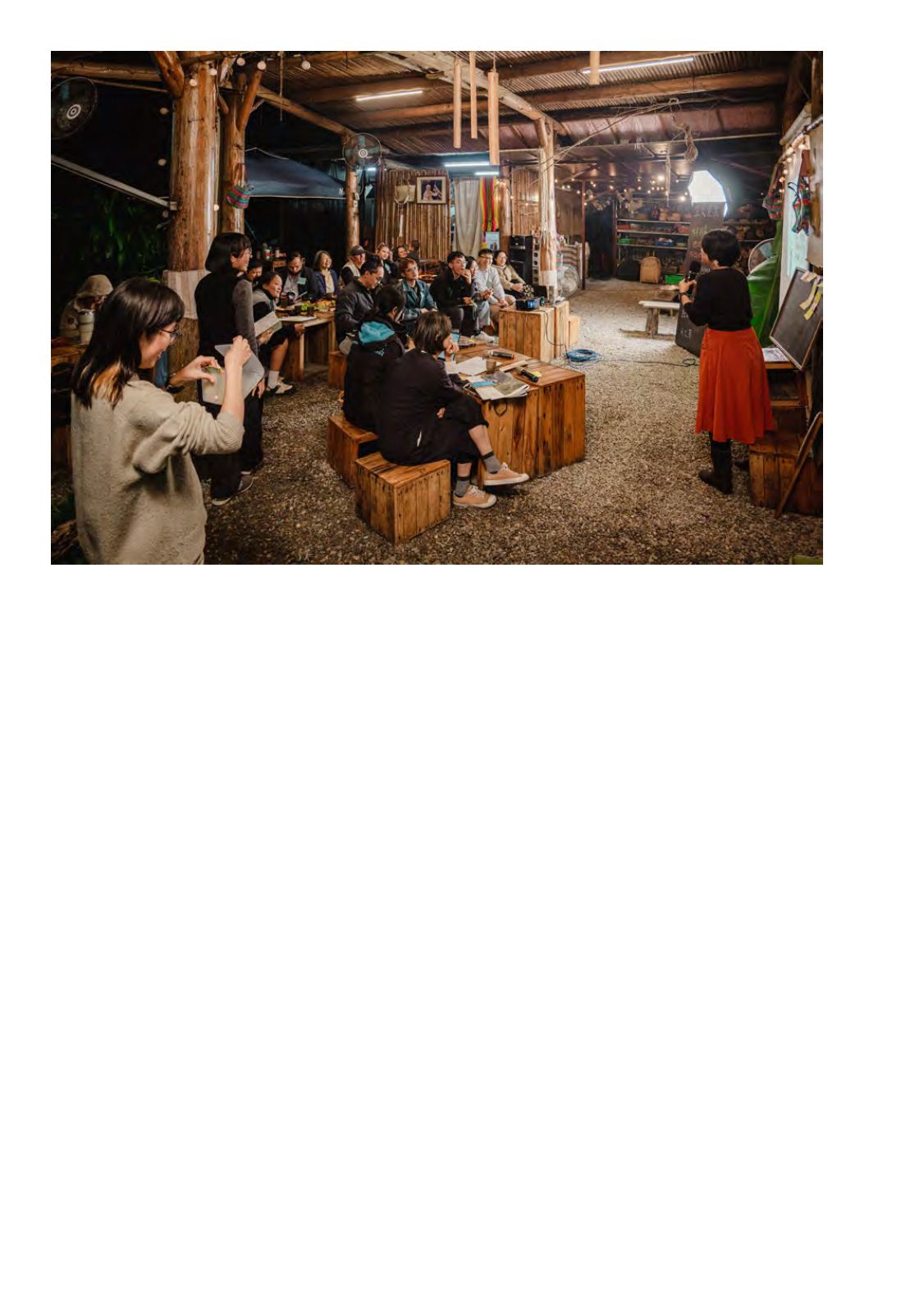
Mayuan Village is largely Bunun. As the hour drew
near, the team from Akay Play Life bustled in the
kitchen. One by one, guests arrived at the gathering
place
—
QMPAH Park. A large pot simmered over a
three-stone hearth, steam rising thick with the scent
of firewood.
The dishes began to arrive, signaling that dinner
was near. Yet before the evening
’
s conversation
—
“
Let
’
s Talk Wanrong
”—
officially began, the food
itself had already answered the host Mu-Hua
’
s
perennial opening question:
If there were a table that represented Wanrong,
what would be on it?
Pork, bird
’
s nest fern, scrambled eggs, bamboo-
tube rice
…
every dish appeared as if spoiling the
answer in advance. When the votes were counted,
first place went
—
unsurprisingly
—
to meat. Whether
transformed into blood-and-meat soup, pork blood
rice, smoked cuts, muntjac, or raw liver, all answers
pointed to the same thing: even-toed ungulates.
Second place went to bird
’
s nest fern, the
backbone of local forest-based economies. Banana
rice and bamboo-tube rice tied for third, hand in
hand.
Yet Wanrong itself is divided
—
by six rivers and
by administrative borders
—
into several distinct
worlds. To travel from the northernmost village to
the southernmost, residents must detour through
neighboring towns
—
Fenglin, Guangfu, and Ruisui
—
before returning once more to Wanrong. Still,
however winding the boundaries may be, the
densely forested peaks stand firm and unapologetic.
At their feet stretches the rift valley plain, stamped
by the giant
’
s footsteps. Administrative frameworks
cannot tame the mountains, nor the people who live
among them.
The day after the winter solstice, our editorial team
invited the mountain people to gather. As dusk
approached, our car rounded the Yayung Qicing
of the Qingshui River
—
the
“
river on the sun
’
s far
side
” —
a name that foretells what follows once
the sun slips behind the mountain: darkness and
dampness advancing without restraint. We are not
mountain people; we bundled ourselves carefully
against the cold.
Most of Wanrong
’
s residents belong to mountain
Indigenous communities. The Truku form the majority,
while Mingli Village is predominantly Seediq, and
Wanrong Township
10